There Is No Universal Timer
A sourdough bulk can finish in a couple of hours in a warm kitchen and take much longer in a cool one. King Arthur Baking describes a three-to-five-hour example, but the schedule depends on the recipe and dough temperature. That is why a timer cannot make the call for you. If the finished loaf is already dense or wet, our gummy-sourdough comparison covers that later-stage symptom.
Read the Dough Temperature First
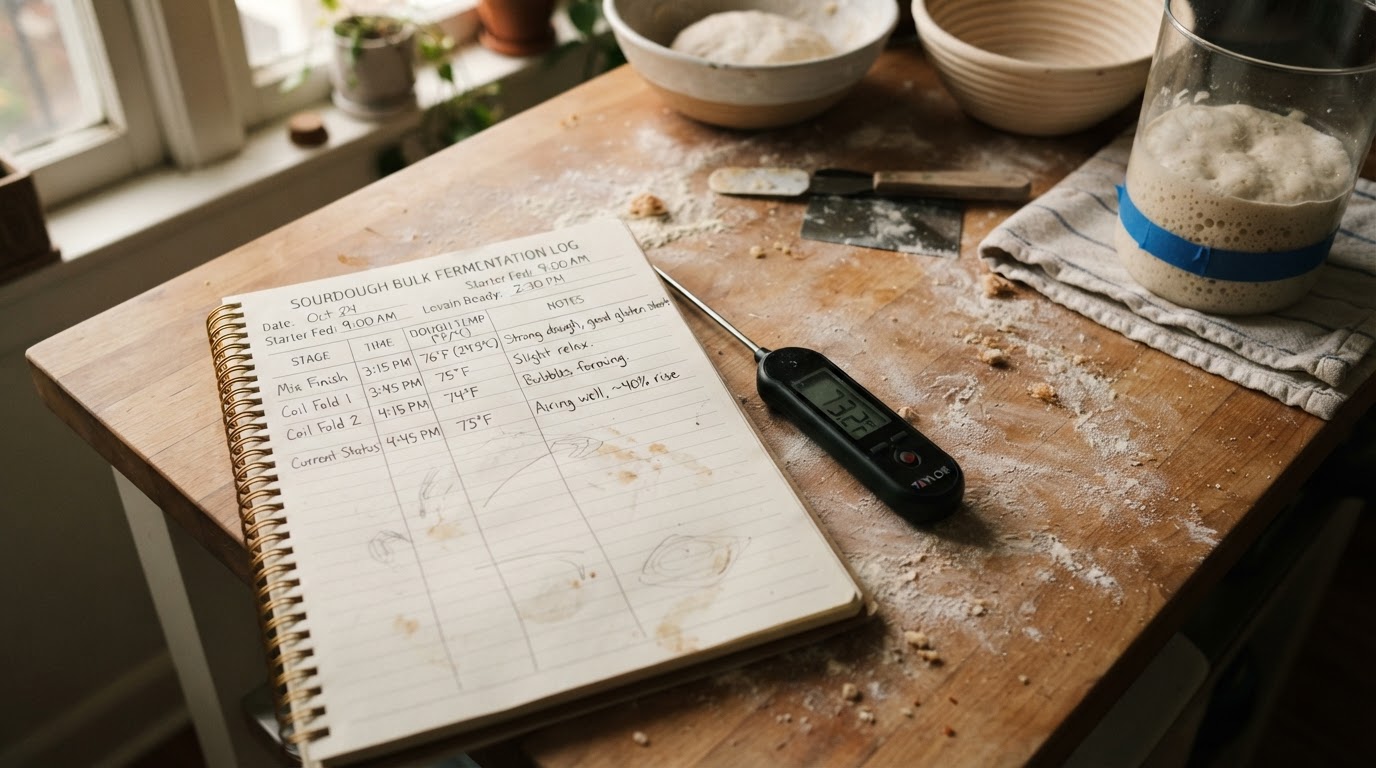
Dough temperature is the strongest lever in bulk fermentation, so measure it instead of guessing. Push a probe thermometer into the center of the mass; the surface tells you very little because a large dough changes temperature slowly. The Perfect Loaf aims for a final dough temperature near 78°F (25°C) and keeps most warm bulks between 74°F and 78°F (23-25°C), a range that usually translates to about two to five hours. Run warmer and expect a faster ferment; run cooler and expect a longer one. As contextual ranges rather than rules, that same guide suggests staying below roughly 85°F (29°C) and not refrigerating below roughly 39°F (4°C).
The Four Signals to Read Together
No single check decides bulk fermentation. Read these four, and let them agree.
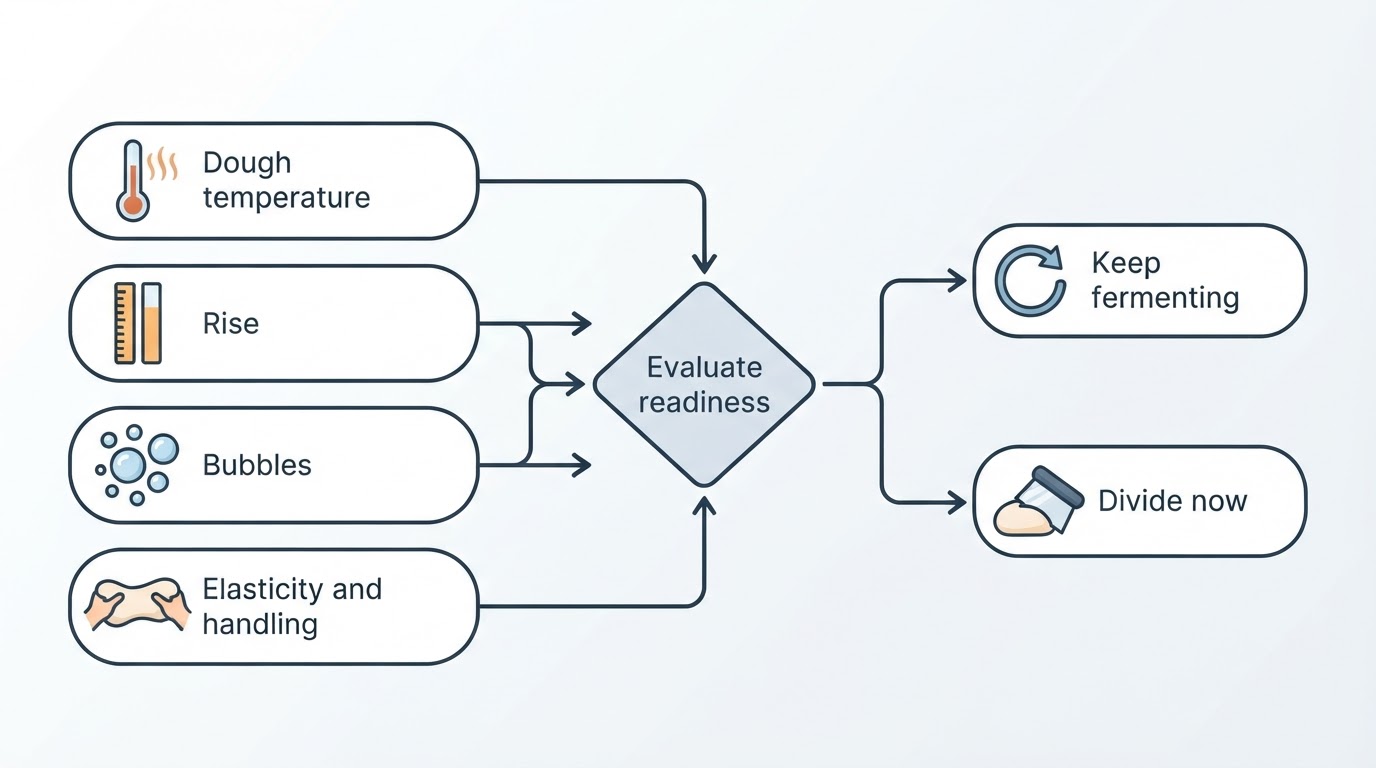
1. Volume and a domed edge. Mark the starting height so "it rose" is an observation, not a feeling, and look for a rounded dome where the dough meets the container. Be careful with percentages: The Perfect Loaf notes that a 70% hydration white dough may nearly double, while a 100% hydration whole wheat dough may rise only around 20-30% and still be ready.
2. Surface bubbles and liveliness. Look for small bubbles across the top and around the sides, then shake the bowl gently. A dough that jiggles is holding gas and structure; a dough that sits flat and heavy is not there yet.
3. Elasticity and handling. Early dough is shaggy and sticky. Finished dough is smoother and stronger: pull a little with a wet hand and it should resist instead of tearing. King Arthur Baking lists strength, elasticity, smoothness, volume gain, and a bubbly surface as the signs fermentation has gone far enough.
4. Dough temperature over time. Temperature is the dial that speeds up or slows down everything else, so track it through the bulk, not only at the start.
Diagnostic Table: What You Are Seeing and What to Do
What you observe | What it usually means | What to do next |
|---|---|---|
Flat, tight, few bubbles, springs back fast when pressed | Fermentation is still early | Keep it warm and recheck in 30 minutes |
Domed edge, visible bubbles, gentle jiggle, resists a tug | The signals agree: it is ready | Divide and preshape now |
Smooth and gassy but barely risen | Likely running cool | Move it somewhere warmer and check again soon |
Slack, sticky, hard to handle, very gassy | On the verge of over-proofing | Handle gently, divide now, and watch the final proof closely |
Sticky and slack with almost no rise | Too much water or too little mixing, not just time | Add a fold or two, wait 15-30 minutes, then reassess |
When two or more signals point the same way, trust them over any single test.
How Flour, Starter Strength, and Temperature Change Timing
Flour sets how much rise is realistic. Whole-grain and rye doughs hold gas differently and often look less inflated than a white dough at the same readiness, so judging them against a white loaf can mislead you. Judge the dough you actually have.
Starter strength changes the pace. A ripe, active pre-ferment moves faster, and The Perfect Loaf notes an overripe levain can push you to divide earlier, while a sluggish starter drags the schedule out. Watch the dough rather than the starter's own timetable.
Temperature is the master variable. Warmer dough ferments faster and needs a shorter bulk; cooler dough needs longer.
Step-by-Step: How to Check Your Bulk
- Write down the start. Note the time mixing finished and the dough's temperature.
- Mark the container. A tape line on the bowl turns rise into a repeatable measurement.
- Fold on a rhythm. King Arthur Baking suggests two to four sets of folds for a hand-mixed dough, spaced about 30 minutes apart; each set also evens out dough temperature.
- Check before the recipe's expected end, then more often as it approaches readiness. Note what changed: height, bubbles, temperature and handling. The interval depends on how quickly your dough is moving.
- Divide when the signals agree. A dough that looks smooth, feels elastic, shows bubbles, and jiggles is ready. If you divide slightly early, The Perfect Loaf notes you can let the shaped dough rest at room temperature before cold proofing to buy back some fermentation.
What the Poke Test Can and Cannot Tell You
The poke test, pressing a floured finger into the dough and watching the dent, was built for the final proof rather than for bulk fermentation. The Perfect Loaf's poke test guide is direct about this: during bulk the dough is stickier and weaker, so the same spring-back does not mean the same thing. Even in proofing it misleads on dough that is cold from the fridge, very high hydration, or heavy with whole grains, where spring-back does not match the dough's real state. Poke if you like, but never let one poke decide.
Three FAQs
Can I just bulk ferment for a set number of hours? No. Time is an outcome, not the target. A room-temperature sourdough bulk commonly lands between three and five hours (King Arthur Baking), while a warm bulk near 74-78°F usually lands between two and five hours (The Perfect Loaf). Your number depends on the temperature.
How much should the dough rise before I stop? There is no single percentage: a white, higher-hydration dough may nearly double, while a whole wheat dough may rise far less and still be ready. Treat rise as one signal, not a score.
Does the poke test work during bulk fermentation? Not the way it works during proofing. It can still show that the dough is changing, but it is unreliable at the bulk stage and unreliable for cold, wet, or whole-grain doughs. Use it as a supporting observation only.
The Completion Standard
Bulk fermentation is done when the dough has risen visibly with a domed edge, shows small bubbles across the surface, jiggles softly when the bowl is shaken, and feels smooth and elastic against a gentle tug, and when its temperature explains the pace you saw. When those signals agree, divide. When they disagree, adjust the temperature, wait, and check again.