What kouign amann is, and why it bakes into layers
Kouign amann is a sweet, round laminated pastry from Brittany, and its name comes from the Breton words for cake and butter. It traces back to Douarnenez in the 1860s, where it is attributed to Yves-René Scordia, and the traditional version starts from a plain bread dough rather than a rich brioche. Butter and sugar are layered through that dough instead of stirred into it. In the oven, steam from the water in the butter pushes the dough apart, while the sugar melts and caramelizes into a brittle, glassy crust. The old Douarnenez proportions are often quoted as 40 percent dough, 30 percent butter, and 30 percent sugar by weight. A smaller version, the kouignette, is shaped like a caramelized croissant baked in a muffin cup and has become more common in North America in recent years (Wikipedia).
How long this really takes, and how to plan it around your day
Set aside most of a day rather than a free hour. One thoroughly tested version runs about six hours from mixing to the last caramel bubble, and almost all of it is waiting: short stretches of hands-on work separated by long chilling and proofing gaps (Leite's Culinaria).
A schedule that fits a normal day: mix the dough in the morning, lock in the butter and complete the folds across the afternoon, then shape, proof, and bake in the evening. The make-ahead part of this pastry is the laminated dough itself, which is meant to rest cold between folds; the baked pastries are a different story, which the storage notes below explain. If one long window is unrealistic, split the work — mix and chill the dough on day one, then fold and bake on day two.
What you need, and what you do not need to buy
The ingredient list is short: bread flour, water, a little yeast, salt, sugar, and butter with enough fat to roll into a pliable sheet. High-protein bread flour gives the dough the stretch it needs to wrap around butter without tearing, and a firm, high-fat butter block behaves much better than a soft spread (Leite's Culinaria).
Tools matter less than most people expect. You need a rolling pin, a palette knife or thin spatula, plastic wrap, and an oven that holds a steady temperature. You do not need a kouign amann mold. A standard muffin tin works, and so does one round cake tin of 22 to 23 cm for the large-cake version. If you want individual pastries with tall, even sides and do not own pastry rings, make disposable ones from heavy-duty aluminum foil: fold a 14-by-4-inch strip into a 14-by-1-inch band four layers thick, wrap it around a 4-inch can to shape it, and secure it with paper clips (Leite's Culinaria). An instant-read thermometer is the one extra worth having, because the doneness check for small pastries depends on the center temperature.
Get the butter right before anything else
Butter at the wrong temperature is the most common reason the layers fail. Aim for 68° to 70°F (20° to 21°C): firm but workable, and the same consistency as the dough. Colder than that, and the butter breaks through the dough as you roll; warmer, and it smears and spreads unevenly instead of forming an even sheet. Press it into a flat slab, let it sit until it bends without cracking, and keep the dough chilled while the butter comes up to temperature (Leite's Culinaria).
Mix the dough, then lock the butter in
Start with a soft, slightly sticky bread dough. Mix the flour, water, yeast, and salt just until no dry flour remains, then cover the bowl and chill the dough until it is cold and relaxed. Roll the dough into a rectangle wide enough to wrap the butter slab. Lay the butter in the middle, fold the dough over it from both sides, and pinch the seams closed so the butter is completely enclosed. Give the packet its first fold and return it to the fridge.
The folds, and when the sugar goes in
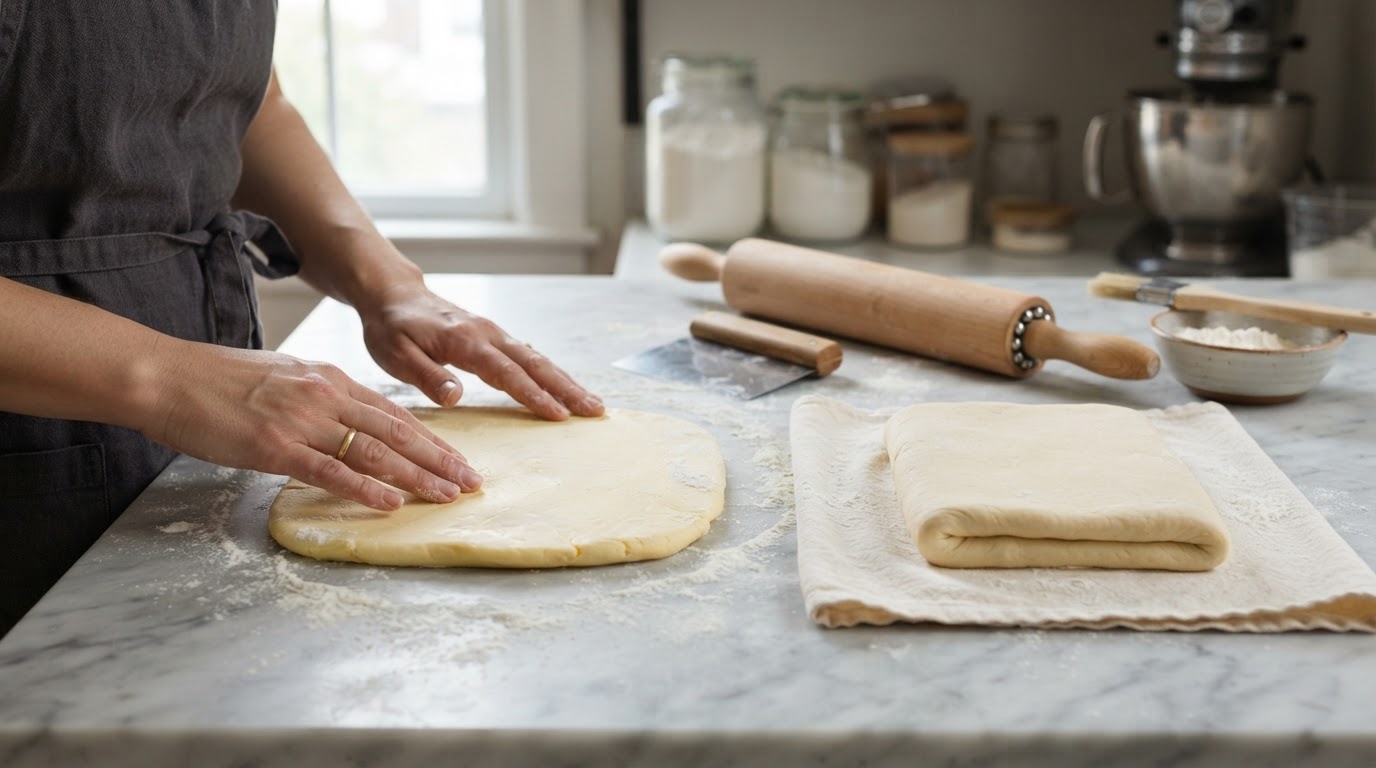
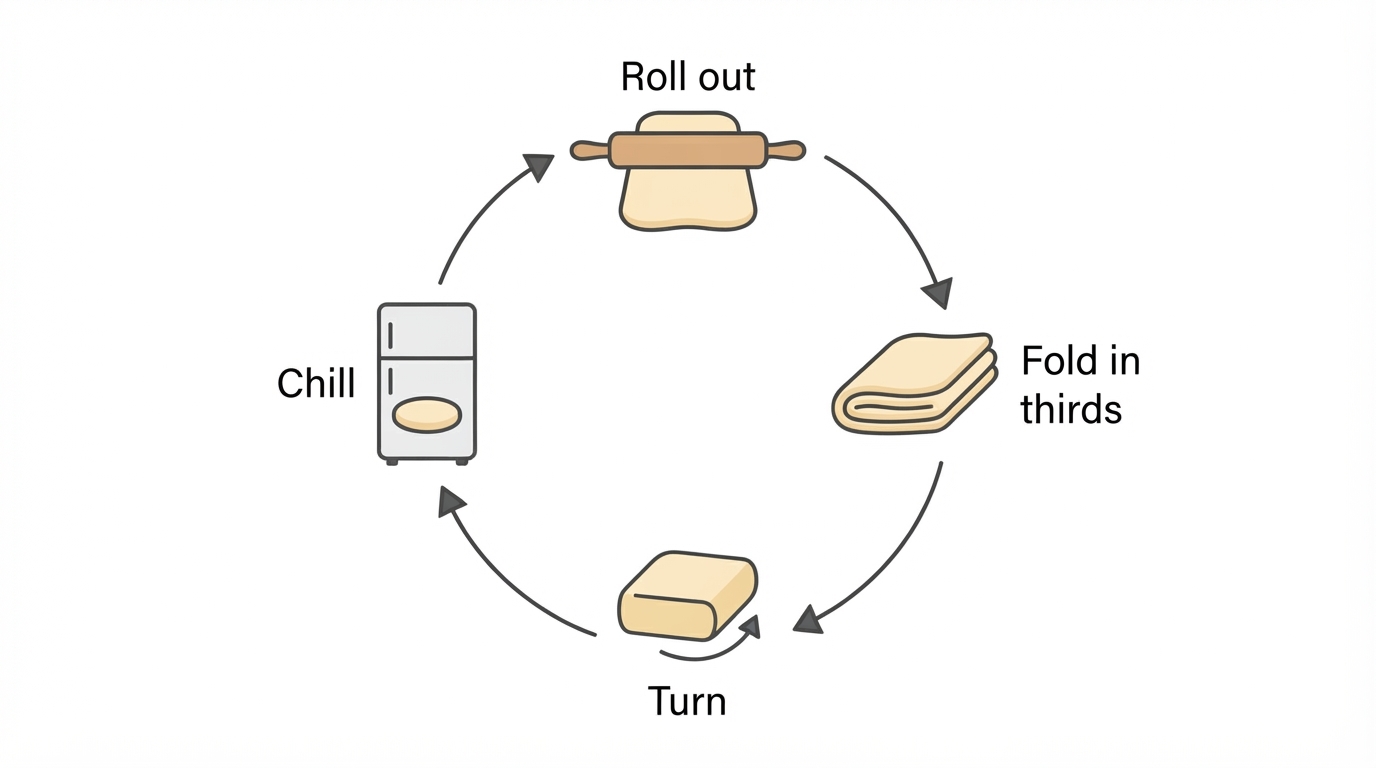
Published versions differ here, and it helps to know that before you choose one. A tested individual-pastry method uses three turns with an hour of chilling between each, and the sugar goes in only at the third turn. A large single-cake version uses two letter folds with 20-minute chills and works the sugar in as the dough is handled (Leite's Culinaria). Either way the motion is the same: roll the dough into a rectangle, fold it in thirds like a letter, turn it a quarter turn, and chill again. Work quickly, keep the dough cold, and if the butter starts looking streaky and soft, a short rest in the fridge will firm it back up faster than any rolling technique.
Shape, proof, and bake
The two formats are different bakes, so choose one and follow its numbers rather than borrowing from the other. The timings below come from tested versions of each, and color is the final judge in both cases.
| Individual pastries | One large cake |
|---|---|---|
Pan | Buttered pastry rings, or a muffin tin | One buttered round tin, 22–23 cm |
Folds | Three turns, 1 hour chilled between | Two letter folds, 20 minutes chilled between |
Oven | 400°F (200°C) | 200°C, conventional |
Bake time | 12 minutes, rotate the pan, then 8 to 15 minutes more | 30 to 35 minutes |
Doneness | Caramelized with deeply browned edges, and 212° to 215°F (100° to 102°C) at the center | Deep amber across the surface, with the edges pulling away from the tin |
For the large cake, prove the shaped dough for 20 to 30 minutes before it goes into the oven. For the individual version, the shaping step is a set of squares placed in the buttered rings, and the center temperature is the clearest signal that the middle is baked (Leite's Culinaria).
The last ten minutes decide everything
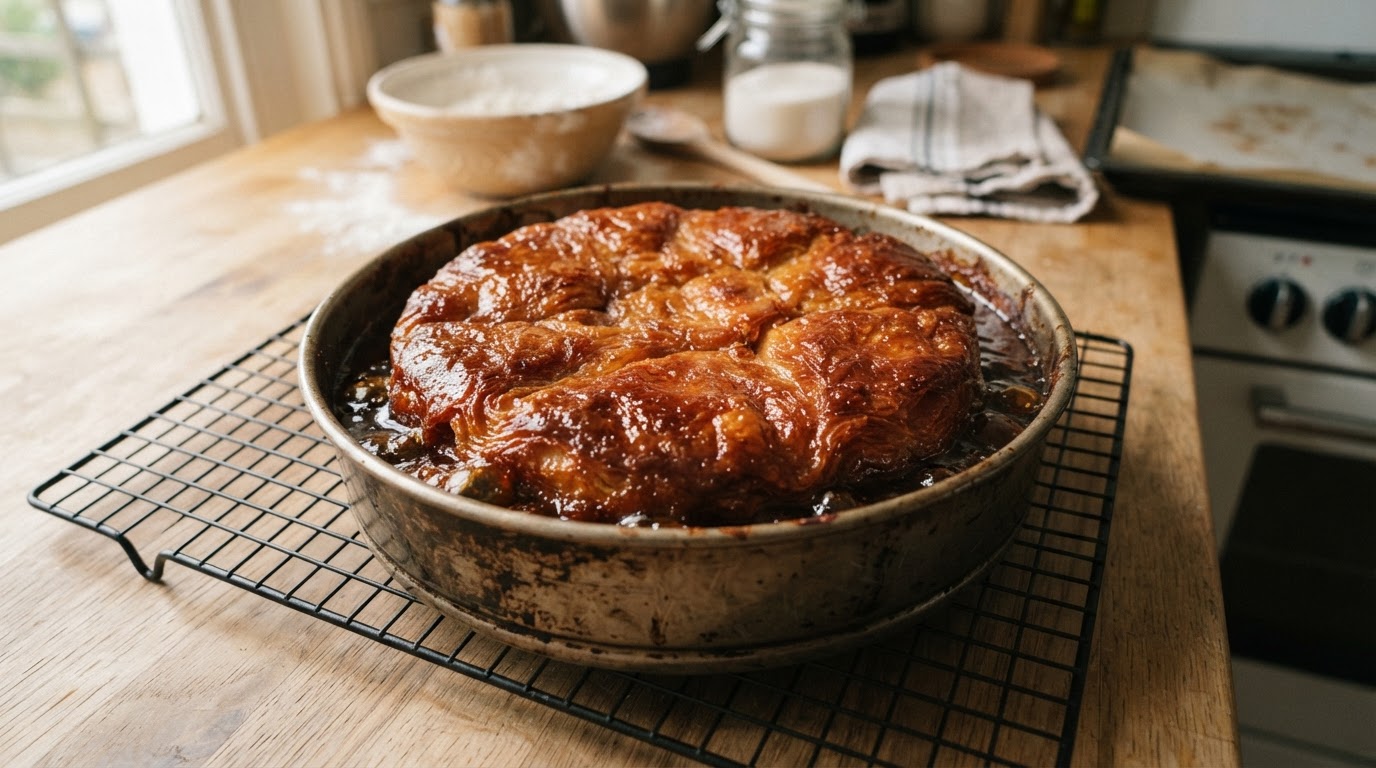
Caramel is the part of this bake that fails fastest. During the final ten minutes the sugar bubbles hard, and it can move from deep amber to burnt in about three minutes, so stay at the oven and watch through the glass. A large cake is done when the surface is deep amber across the top and the edges are pulling away from the tin; small pastries are done when the edges are deeply browned and the center reads 212° to 215°F. Once the cake comes out, leave it in the tin for exactly five minutes, then run a palette knife around the edge and turn it out before the caramel sets hard (homemade.education).
What goes wrong, and how to catch it early
- Butter breaking through the dough. The butter was too cold. Let it warm to 68° to 70°F and keep the dough well chilled between steps.
- Uneven, greasy layers. The butter was too warm and smeared. Chill the packet longer than feels necessary, and work in shorter bursts.
- A burnt top and bitter edges. The caramel window is only about three minutes wide at the end. Pull the pan when the surface is deep amber, not dark brown.
- Pale, soft pastries. Not enough caramelization. Bake longer within the range for your format and judge by color rather than the clock.
- Timings that do not match another recipe. Published versions genuinely differ: a single large tin baked at 200°C for 30 to 35 minutes is a different bake from individual rings at 400°F for a total of 20 to 27 minutes. Follow one tested version from start to finish (homemade.education, Leite's Culinaria).
Where to go when you want a scratch bake without the laminate
Kouign amann sits at the ambitious end of from-scratch baking. For the weekends when you want something homemade that does not ask for a butter block and three chilled folds, The Rustic Bakehouse keeps its cakes and pastries in one collection: the tiles there include a caramel bundt cake alongside a kouign amann, and the recipe cards list prep and cook times, yield, equipment, and a step-by-step method, so you can see the whole project before you start. It is a natural next stop when a full laminate will not fit your weekend. The guide above stands on its own either way.
All Recipes listing first screen: 4-column recipe card grid with photos, tags, titles, excerpts and pagination.
Storing what you do not eat the same day
These pastries are at their best on the day they are baked. After that, keep them in a paper bag at room temperature for about two days, and revive them in a 350°F oven for 3 to 5 minutes before serving. Reheating brings the crust back; the layers underneath are still at their peak on day one (Leite's Culinaria).